
Every year brings another list of "sport fishing trends." Almost none of them cite a source. We decided to do it differently: we took eight fronts — law, tournaments, fish, reservoirs, lures, tackle, electronics, boats — and published only what we could confirm against a primary source. Statute text as consolidated. Peer-reviewed papers with DOIs. Manufacturer spec sheets. Operational data from Brazil's grid operator.
Some of it was uncomfortable. Three claims that circulate widely in Brazilian fishing did not survive verification, and one of them appears in practically every piece of Portuguese-language content about peacock bass.
When we write "the law says", there is an article number checked against the consolidated text. When we write "the literature shows", there is a DOI. When something is our own practice, we say so. And when we could not confirm something, we say that too — there is an entire section at the end for what stayed unanswered.
1. Goiás law defines how you fish, not just what you may keep
We start here because it is what most people get wrong. In the state of Goiás, "sport fishing" is not a turn of phrase — it is a legally defined discipline, distinct from amateur fishing. State Law 13.025/1997, article 5, III, as amended by Law 17.985/2013, defines it as:
"sport fishing: that practised for leisure and sport, distinguished from amateur fishing by the catch-and-release system, practised solely with barbless hooks, whether from a boat or from shore, with zero quota established for transporting the fish caught, permitting only consumption by the participants at the site where the fishing takes place."
Three things are built into that sentence, and none of them is optional: catch and release, barbless hooks, and a zero quota for transport. This is not a tournament rule or a best-practice recommendation. It is the definition of the discipline.
It is worth flagging that this is our reading of the consolidated state statute. Part of the material we gathered supports a narrower reading, under which the barbless requirement would apply specifically during the closed season, based on a SEMAD normative instruction. The two readings come from different primary sources, and we could not resolve the conflict with what we have — the state's official portals have suspended publication under electoral-period restrictions. When in doubt, the conservative course matches the statute: barbless, always.
Another provision of the same law that almost nobody knows — article 10, V, (f): it is predatory fishing, prohibited throughout the state, to fish within 500 metres upstream or downstream of dams, waterfalls, fish ladders or the mouths of bays. All year. The "200 m" and "1,000 m" figures that circulate as if they were federal rules belong to other states: federal Law 11.959/2009 sets no dam distance at all — we checked by full-text search.
2. Two home lakes, two legal regimes
This is the finding that most affects our own routine, and probably that of any team fishing both ends of the state.
Annex I of Law 13.025/1997, as amended by Law 19.337/2016, sets catch sizes by river basin. And the two basins of Goiás are not treated the same way:
| Base | Basin | Species | Size |
|---|---|---|---|
| Serra da Mesa | Araguaia-Tocantins | Blue peacock bass (Cichla piquiti) | 30 to 50 cm |
| Serra da Mesa | Araguaia-Tocantins | Red peacock bass (Cichla kelberi) | 30 to 40 cm |
| Corumbá IV | Paranaíba | Peacock bass | no size set in the annex |
Note what almost everyone misses: there is a maximum size, not only a minimum. Taking a fish above the ceiling is predatory fishing under article 10, III. On a lake where a team is hunting the big one, that is not a footnote.
For anyone practising full catch and release, catch size matters less in practice — the fish goes back either way. But it matters for understanding that the two bases are not under the same regime, and that the same fish, at the same length, is treated differently depending on which side of the state you are on.
3. The closed season sets the competition window
The closed season in Goiás runs from 1 November to 28 February and expressly prohibits tournaments. That leaves a legal competition season running from 1 March to 31 October — eight months.
It is no coincidence that the 2026 Circuito Goiano calendar opens on 7 March in Quirinópolis and closes on 31 October in Três Ranchos. The entire season fits inside the legal window, flush against both edges.
The circuit, incidentally, has its own state law — Goiás Law 24.070/2026. What it does not have is a published rulebook: the rules live in the site's FAQ, and the regulation PDF is offline. The scoring system is not publicly verifiable today.
There are two Goiás circuits with nearly identical names and different formats: the Circuito Goiano de Pesca Esportiva, fished in teams of three, and the Circuito Goiás, fished in pairs. When looking up rules, calendars or entries, check which of the two a page refers to.
4. The fish: the error that is almost everywhere
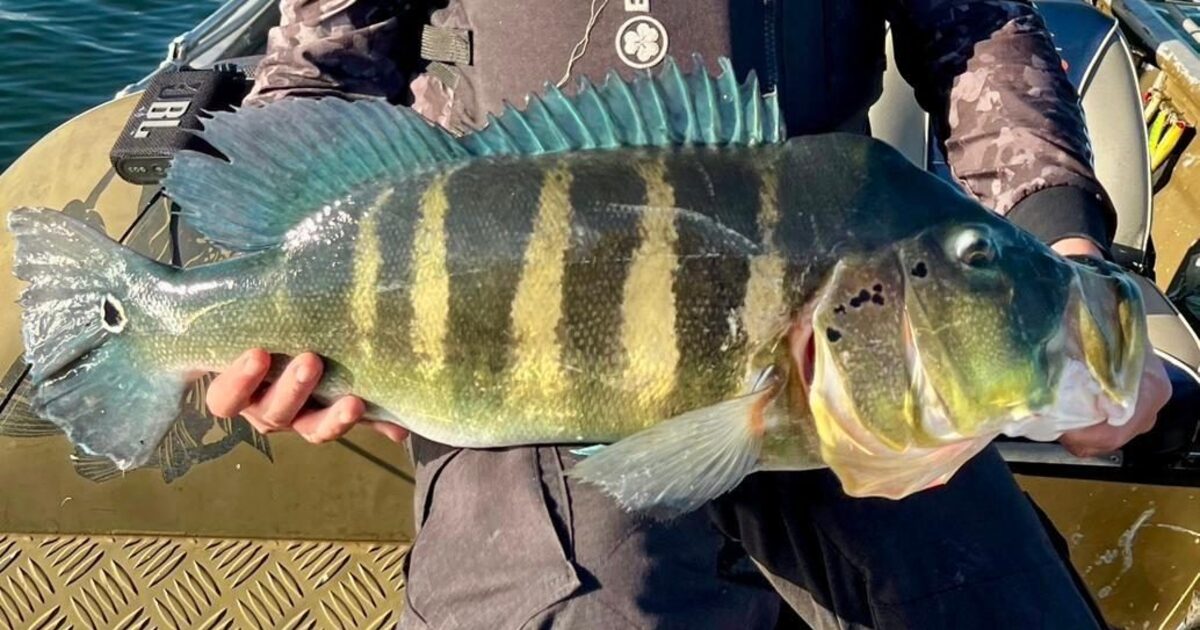
An enormous amount of Brazilian fishing content cites Cichla ocellaris as the local peacock bass. That species does not occur in Brazil. The two peacock bass species of Goiás are Cichla piquiti and Cichla kelberi, both described by Kullander & Ferreira in 2006 — which means every pre-2006 source uses superseded names.
The second part is more uncomfortable, and we are not going to soften it: whether the peacock bass is native depends on the basin.
At Serra da Mesa, on the Tocantins river, the blue peacock bass is native. Cichla piquiti is endemic to the Tocantins-Araguaia basin — published in Neotropical Ichthyology (Marto, Akama & Pelicice, 2015).
At Corumbá IV, in the Paranaíba basin, it is introduced. That is not an environmentalist's opinion: it is the classification used by the dam's own monitoring programme. Corumbá Concessões' ichthyofauna protection programme has recorded 48 species in the lake since 2018 and classifies 11 of them as allochthonous — species from other Neotropical basins, introduced into the upper Paraná with no evidence of natural occurrence there.
We fish both. It matters to know which one the fish is actually from.
What the science shows about impact
We went looking for both sides deliberately, because the literature is not unanimous.
The most severe case is the Rosana reservoir, on the Paranapanema. Pelicice & Agostinho (Biological Invasions, 2009) followed the 2004 introduction of C. kelberi and, two years later, measured roughly 95% lower density and 80% lower richness among small fish in macrophyte beds. The authors projected the assemblage would disappear by 2010 if the rate held.
The counterpoint came from the same reservoir. Ferrareze & Nogueira (Brazilian Journal of Biology, 2015) concluded that Cichla had not deeply affected the assemblages over the short and medium term, pointing to cannibalism and macrophyte cover as buffers.
The reconciliation is in Franco and colleagues (Aquatic Conservation, 2022), on the Paraíba do Sul: the effect is real and is specific to the small size class — fish under 120 mm — and it vanishes when you look only at aggregate indicators. The two earlier groups were measuring different things. Anyone citing "no impact" from total richness is measuring in the wrong place.
And there is a point on which the literature converges, worth more than the methodological quarrel: the scientific critique does not ask for an end to sport fishing — it asks for an end to moving fish between basins, which is already illegal in Brazil. Azevedo-Santos and colleagues (Natureza & Conservação, 2015) argue that the purely regulatory approach has failed in a country this size, and propose education and information instead, with anglers as agents rather than adversaries. In Goiás, article 6, §1 of the state law is explicit: introducing a non-native species, or a native one that does not occur in the state, requires SEMAD licensing.
Post-release mortality: the disagreement is about method
We asked the obvious question for anyone practising catch and release: does the fish survive? The honest answer is that the disagreement in the literature is not about results, it is about endpoints — about what each study chose to measure. Low direct mortality, in the 2 to 5% range, coexists with documented sublethal effects: physiological stress, altered behaviour, loss of condition.
And there is a gap that needs saying: no post-release mortality study has been done in a Cerrado reservoir. The numbers in circulation come from other environments, other species, other water temperatures. Applying them to Corumbá IV in October is extrapolation, not data.
5. The two lakes run on opposite regimes
Here the grid operator's numbers tell a story that changes how you read the water. Corumbá IV and Serra da Mesa are not "two big reservoirs" — they are reservoirs of opposite nature.
| Corumbá IV | Serra da Mesa | |
|---|---|---|
| Normal maximum level | 842.60 m | 460.00 m |
| Minimum operating level | 837.00 m | 417.30 m |
| Operating range | 5.60 m | 42.70 m |
| Usable / total volume | 24.7% | 79.5% |
| Level on 21 Sep 2026 | 840.91 m (67.8% usable) | 444.95 m (49.2% usable) |
| Below maximum today | ~1.7 m | ~15.1 m |
Corumbá IV is effectively run-of-river: the shoreline structure — timber, stumps, banks, creek mouths — rises and falls inside a band of under six metres. What you marked on the GPS in March is probably still there in October.
Serra da Mesa is another planet: up to 42.7 metres of range. The entire littoral zone migrates tens of metres vertically across the cycle. In September 2026 the lake sits fifteen metres below its normal maximum. A spot memorised one season can be dry land the next.
On what that does to catch rates, we have to be blunt: we found no Brazilian peer-reviewed study linking drawdown to peacock bass catch or to submerged structure in a Cerrado reservoir. What exists is indirect — Miranda & Meals (2013), in the United States, show that fishing effort follows an arc against water level, peaking at intermediate levels, and separate "catch rate" from fishability: at low water the fish concentrate, but access gets worse. It is a useful mental model. It is not Cerrado data.
And the "biggest lake in Brazil" line
We checked, because it is exactly the kind of claim that repeats without verification. Sorting the grid operator's full reservoir dataset: Serra da Mesa genuinely is Brazil's largest by volume, at 54,400 hm³ at maximum level, ahead of Tucuruí (50,275) and Sobradinho (34,116).
By surface area, though, the claim is false: Serra da Mesa's 1,784 km² is far behind Sobradinho's 4,214 km² — more than twice the area with 63% of the volume. The difference is geomorphological: Serra da Mesa is a deep, narrow valley; Sobradinho is shallow and sprawling across the semi-arid. "Brazil's largest artificial lake" is only true when followed by "by water volume."
6. Electronics: forward-facing sonar is being restricted
2026 moved electronics on two fronts at once: a rule limiting use, and a generational change that retired the previous architecture. The rule matters more to anyone competing.
B.A.S.S. announced in September 2025 that from 2026, forward-facing sonar will be allowed in at most 5 of the 9 regular Elite Series events, with the events drawn at random. In the rest it is banned, official practice included. The existing limits stay: one transducer per angler and a maximum of 55 inches of combined screen. MLF went further, restricting use to one of the day's three competition periods, declared in advance.
The argument is not technical but sporting — in the words of the B.A.S.S. CEO, "no single technology should define Bassmaster competition." And the rule did not get rolled back: the 2026 season ran start to finish under the split format, closing on 30 August with Trey McKinney taking Angler of the Year. We went looking for evidence of a reversal, an injunction or a retreat, and found none.
One precision that matters, because the distortion travels widely: forward-facing sonar was not banned. It was partly restricted — by event at B.A.S.S., by time window at MLF. The only outright ban we located is in MLF's high-school category during the regular season.
No Brazilian circuit has an equivalent rule, as far as we could verify. And here we need to be honest about the limits of what we found: because the Circuito Goiano rulebook is not published, there is no way to state what it says about electronics — for or against. No published rule is not the same as no rule.
The generational change Brazilian retail has not caught up with
On 7 July 2026 Garmin launched LiveScope 2, and the structural change is that the GLS 10 black box is gone: the transducer connects straight to the display and to power. Lowrance made a similar move in January with ActiveTarget 2 XL, delivering Forward, Down and Scout from a single transducer with no mechanical adjustment. The resolution and range gains announced are manufacturer claims, not independent measurement — and in LiveScope 2's case Garmin disagrees with itself: the press release says 250 feet, while the transducer guide publishes bottom tracking of 200 feet in fresh water and 150 in salt.
This has a direct consequence for anyone buying in Brazil:
| Sold here | Brazilian price | Global status, September 2026 |
|---|---|---|
| Garmin LiveScope Plus (GLS 10 + LVS34) | ~R$ 17,890 | Previous generation since 07/07/2026 |
| Lowrance ActiveTarget 2 | ~R$ 17,990 | Previous generation since 14/01/2026 |
| Humminbird MEGA Live 2 | ~R$ 18,912 | Current generation (MSRP US$ 1,499.99) |
Anyone paying close to eighteen thousand reais for a LiveScope Plus is buying the black-box architecture the manufacturer has just retired. That is not a defect — the unit works exactly as it did before. But it is worth knowing what you are buying.
MEGA Live 2 does not work with HELIX — only with XPLORE, APEX and recent SOLIX G3 firmware. HELIX is precisely what Brazilian retail sells as the entry option.
TargetLock exists only on the Minn Kota Ultrex and Ultrex QUEST. Ulterra, Terrova and Riptide do not have it, not even in QUEST trim.
The Fortrex has no Spot-Lock, no AutoPilot and no remote. That is 112 pounds of thrust with no virtual anchor at all.
Worth recording what did not change: bow-mount thrust has been stuck in the 100 to 115 pound range for years, and none of the four major manufacturers launched a new platform in 2026. Peak current draw converges around 52 to 59 A across every top-of-range model measured, which means battery bank and breaker sizing barely differ between brands — it is not a selection criterion. The 2026 contest was fought over sonar and motorised aiming, not over power.
Bottom mapping: the best data for our lakes is public and free
This was the biggest surprise of the whole exercise, and it holds for any team fishing central Brazil.
First the diagnosis. Navionics no longer exists as its own site — the address redirects to Garmin, and any old bookmark is broken. And coverage of Brazilian reservoirs in the commercial products is, to be blunt, token. Corumbá IV, Serra da Mesa, Furnas, Três Marias and Itaipu carry no surveyed bathymetry in those products: only a community map, assembled from what users themselves recorded while running.
The size of that community effort says everything. Since 2008, the whole of Brazil has contributed 150,657 updates — 0.64% of the world total. Furnas has 606. Três Marias has 33. Tucuruí has zero. Lake Guntersville, a mid-sized Alabama lake, has 43,560 on its own — seventy-two times what exists for Furnas. On the competing platform, Brazil accounts for 67 water bodies out of 22,309 worldwide, none of them in Goiás.
Now the good part. Brazil's national water agency publishes surveyed bathymetry for around 130 hydroelectric reservoirs, free of charge — contour lines, a digital model of the bottom, a technical report and the elevation/area/volume table. Both lakes we care about are there: the Corumbá IV file runs to 702 MB and Serra da Mesa to 607 MB. Furnas, Três Marias, Itumbiara, Serra do Facão and Tucuruí are included too. Itaipu is not, being binational.
Which means: for the lakes of Goiás, the free public data beats the commercial product — a real survey against a few hundred community traces. The cost is not money but labour: the files arrive in GIS formats, and someone has to convert them into whatever the chartplotter reads. We did not test that conversion, so we cannot say how dense the contours are in practice — anyone attempting it should open one file before betting a season on it.
One detail closes the subject: no official nautical chart exists for any Brazilian reservoir. We went through the Navy's entire catalogue, roughly 360 titles — there are 143 charts of the Paraguay river and 44 of the Amazon, but none of Furnas, Três Marias, Serra da Mesa, Itaipu or Tucuruí. The single inland exception is Lago Paranoá, in Brasília.
7. Boats and motors: what actually exists in Brazil
A good deal of what gets said about Brazilian-built bass boats is folklore. We went after the spec sheets.
Brazilian yards that formally market the category do exist. Confirmed on the manufacturers' own sites: Levefort (Paulínia, São Paulo; marine aluminium; "Bass Edition" line), Quest Boats (São José dos Pinhais, Paraná; fibreglass), UAI Náutica (São Sebastião do Paraíso, Minas Gerais; Black Bass and Gold Bass lines), Mega Bass (Curitiba, Paraná) and Xboats (Campo Grande, Mato Grosso do Sul).
The typical aluminium reservoir hull in Brazil runs 5.0 to 6.2 metres, with 40 to 200 HP. That ceiling comes from what is offered, not from law: Brazil sets no regulatory power limit for recreational craft.
Meanwhile, some names that circulate as "Brazilian manufacturers" simply do not exist. "Tracker do Brasil" is not domestic production — Tracker is a US brand. "Bassboat Brasil" stopped being a factory: it became Mega Bass in 2012, and the name now survives as a discussion group.
The legal obligation many people miss
The governing rule is NORMAM-211/DPC, the Maritime Authority's standards for sport and recreational craft, 1st edition, last amended by DPC Ordinance 200 of 27 February 2026.
A "miúda" (small craft) under the rule is one up to 6 metres. And here is the trap: the registration exemption applies to hulls whose main propulsion is oar or sail, with an auxiliary motor up to 5 HP. An aluminium boat of 5 to 6 metres whose outboard is the main propulsion is not exempt — it needs a TIE (vessel registration title), now issued with a QR code through the Gov.br app and valid for five years.
For inland navigation in small craft the required kit is short: Class III or V life jackets matching the number of people aboard, navigation lights if running at night, the registration number marked on the hull, the TIE, and an Arrais-Amador licence. Extinguisher, anchor, lifebuoy and whistle are not required in this category. The Class V jacket, incidentally, is defined in the standard as the one intended for sporting activities, naming sport fishing explicitly.
One catch worth knowing: required equipment follows the classification stated on the TIE, not where the boat happens to be navigating.
Motors: the two-stroke is not dead in Brazil
Unlike Europe and the United States, two-stroke outboards are still sold new in Brazil at the low and middle end. Suzuki keeps two separate families in its catalogue — the DT two-stroke line and the DF four-stroke — and Mercury offers two-strokes from 3.3 to 50 HP. The cutoff sits around 50 HP: above it, the Brazilian offering is four-stroke with electronic fuel injection.
One factual correction worth recording: Evinrude has been discontinued since 2020. This is not forum rumour — it is in the Form 6-K BRP filed with the SEC on 27 May 2020, announcing the end of E-TEC and E-TEC G2 production and a supply agreement with Mercury. Every Evinrude still running today is at least six years old and depends on remaining parts stock.
Electric outboards: not for this job yet
The question always comes up, so here is the answer in numbers. The electric outboard with the best public specification is the ePropulsion X40, at 40 kW — around 54 HP, or 80 HP in turbo. A 20-foot bass boat wants 250 HP. The power gap is a factor of three to five, and the energy gap is worse: the Mercury Avator 7.5e, at 3.5 HP, delivers about an hour at full throttle and needs roughly nine hours to recharge. That is incompatible with a tournament day.
Beyond that, we could not confirm a single active official distributor of electric outboards in Brazil in 2026 — the most recent reference we found dates from 2013. And we found no source, in either direction, on charging infrastructure at Brazilian reservoirs.
Where electric already makes sense: small hulls, marina work, lakes that restrict combustion. As a replacement for the outboard on a competition boat in a large reservoir, not in 2026.
A detail for anyone following the industry: Torqeedo was not sold by Deere, as is sometimes written. The seller was DEUTZ AG, and the buyer was Yamaha Motor, closing in April 2024.
8. Lures: what is practice and what is rule
We need to be explicit about the status of what follows. There is no primary source on "when to use which lure" for Cichla. What exists is accumulated practice — ours and that of the people we compete against — and practice is not technical fact, however well it works.
What is rule, and was covered above: in Goiás, the sport fishing discipline is defined with barbless hooks. That has a direct bearing on tackle choice and preparation, and it is the only point in this section carrying legal weight.
As for the rest — prop baits on flat water in the first sun, walking baits when fish are active on top, jigs when they drop and pin to structure — we treat it as what it is: what we have seen work on Corumbá IV and Serra da Mesa. It holds for our water, in our season, with our way of fishing. Publishing that as universal technique would be the same error we criticised at the top of this piece.
What we could not confirm
This section exists because without it the piece would sound more confident than the data allows.
- The 2026/2027 closed-season rules for Goiás. They are set by SEMAD administrative act, and the state's portals have suspended publication under electoral restrictions. We used the consolidated statute, which is more stable — but the annual act, with exact dates, was not located.
- The barbless-hook conflict — whether the requirement holds year-round, by the definition of the discipline, or only during the closed season, by normative instruction. Two primary sources, two readings.
- The Circuito Goiano scoring system. The rulebook is unpublished; the PDF is offline.
- Which Cichla species occur in Corumbá IV. The full named list of the 48 species from the dam's monitoring is not public. We know peacock bass are there — we do not know from a primary source whether that is piquiti, kelberi, or both.
- A fish survey for Serra da Mesa. No public species checklist exists for the reservoir in a primary source.
- The reference level for surface areas. Neither Corumbá IV's 173 km² nor Serra da Mesa's 1,784 km² comes with a stated elevation. Reservoir area varies greatly between maximum and minimum — and on a lake with 42.7 m of range, greatly indeed.
- Boat rules in Brazilian circuits. None publishes a hull or power limit in an accessible source.
- Contour density in the water agency's files. We opened none of the geodatabases. Before planning a season around them, convert one and look at the result.
- The B.A.S.S. rulebook as a PDF. Not located, so how enforcement works at the non-sonar events — and what happens to side imaging, 2D and spot-lock there — remains unknown.
- MLF's official release. The site blocked automated access; everything we read came from republication, and the exact date differs across four outlets.
- Lowrance specifications. Every domain of the brand blocked automated access. ActiveTarget 2 frequency and range, and the Ghost X's absolute thrust — which Lowrance does not publish in pounds, only as a percentage over the previous model — went unconfirmed. Where Lowrance appears above, the source is the official release as reproduced by third parties, not the spec sheet.
- Official Brazilian distributors for electronics. No manufacturer confirms one through its own dealer locator; what exists is self-declaration by resellers.
- Anatel certification for models with Wi-Fi and Bluetooth — not checked, and it bears on both legality of use and warranty for imported gear.
- Forward-facing sonar rules for 2027. No circuit had announced anything as this piece closed.
A note on method: this research ran into the available search limit and into automated-access blocks on several manufacturer sites. Where that affected the work, it is stated above. We would rather publish with the gaps visible than fill them with assumption.
What we take from it
Two things.
First, the rules in Goiás are stricter than boat-ramp conversation suggests. Barbless hooks in the definition of the discipline, 500 metres from any dam all year, a maximum size as well as a minimum on the Tocantins, mandatory registration for a boat whose outboard is its main propulsion. None of that is interpretation — it is statute and standard.
Second, conservation has stopped being a matter of style. When you fish a species that is native in one of your lakes and introduced in the other, with peer-reviewed literature documenting impact on small fish, catch and release stops being marketing and becomes the only coherent stance. The scientific critique is not aimed at people who fish. It is aimed at people who move fish between basins. Those are different things, and the distinction is worth insisting on.
We intend to keep this piece alive. When the state portals resume publishing and the gaps can be closed, we will update it — and say what changed.
Sources
Consulted and verified on 22 September 2026.
- Goiás State Law 13.025/1997, consolidated text (as amended by Laws 15.894/2006, 17.985/2013, 19.337/2016 and 21.215/2021) — Casa Civil of the State of Goiás, base updated 23/06/2026. Articles 5-III, 6-§1, 9, 10, 12, 22 and Annexes I and II.
- Federal Law 11.959/2009 — National Policy for Sustainable Development of Aquaculture and Fisheries. Planalto.
- Federal Law 12.651/2012 (Forest Code), articles 4-III, 5, 8 and 9. Planalto.
- Goiás State Law 24.070/2026 — Circuito Goiano de Pesca Esportiva.
- NORMAM-211/DPC — Maritime Authority Standards for Sport and Recreational Activities, 1st ed., Rev. 1; last amended by DPC/DGN/MB Ordinance 200 of 27/02/2026. Brazilian Navy.
- ONS Open Data,
RESERVATORIOS.csvandDADOS_HIDROLOGICOS_RES_2026.csv, reading of 21/09/2026. - ANEEL — SIGA, generation information system.
- Corumbá Concessões S.A. — technical information, overview, and ichthyofauna protection programme.
- ANA — Brazilian National Water Agency, note on Serra da Mesa, 27/03/2023.
- Marto, Akama & Pelicice. Feeding and reproductive ecology of Cichla piquiti within its native range, Lajeado reservoir. Neotropical Ichthyology, 2015. DOI 10.1590/1982-0224-20140165.
- Pelicice & Agostinho. Fish fauna destruction after the introduction of a non-native predator (Cichla kelberi) in a Neotropical reservoir. Biological Invasions 11:1789–1801, 2009. DOI 10.1007/s10530-008-9358-3.
- Ferrareze & Nogueira. Impact assessment of the introduction of Cichla kelberi in a large Neotropical reservoir. Brazilian Journal of Biology 75(4), 2015. DOI 10.1590/1519-6984.05814.
- Franco, Petry, García-Berthou & Santos. Invasive peacock basses (Cichla spp.) and decreased abundance of small native fish in Brazilian reservoirs. Aquatic Conservation, 2022. DOI 10.1002/aqc.3874.
- Vieira et al. Population structure and reproductive biology of Cichla piquiti in a Neotropical reservoir. Neotropical Ichthyology, 2009. DOI 10.1590/s1679-62252009000400024.
- Azevedo-Santos, Pelicice, Lima-Junior, Magalhães, Orsi & Vitule. How to avoid fish introductions in Brazil: education and information as alternatives. Natureza & Conservação, 2015. DOI 10.1016/j.ncon.2015.06.002.
- Agostinho, Pelicice & Gomes. Dams and the fish fauna of the Neotropical region. Brazilian Journal of Biology, 2008. DOI 10.1590/s1519-69842008000500019.
- Miranda & Meals. Water levels shape fishing participation in flood-control reservoirs. Lake and Reservoir Management, 2013. DOI 10.1080/10402381.2013.775200.
- Bassmaster / B.A.S.S. — announcement of forward-facing sonar rules for the 2026 season, published 02/09/2025.
- BRP Inc. — Form 6-K, Exhibit 99.1, "BRP Advances Marine Strategy by Focusing on Boats and New Technologies", U.S. Securities and Exchange Commission, 27/05/2020.
- Torqeedo GmbH — statement on the transfer of control from DEUTZ AG to the Yamaha Motor Group, 03/04/2024.
- Official spec sheets: Levefort, Quest Boats, UAI Náutica, Mega Bass, Xboats, Suzuki Marine Brasil, Mercury Marine, ePropulsion.